Is Medium still relevant in 2026? Yes - but whether Medium is worth it depends on what you're using it for. Medium is still a major publishing platform for personal essays, tech explainers, and independent writing, with a large built-in readership and a real way for writers to earn money through the Medium Partner Program.
But being relevant isn't the same as being the best option for every writer or reader. Medium's metered paywalls, membership prompts, and increasingly subscription-driven model can make the reading experience frustrating, while writers have to weigh Medium's built-in audience against its monetization rules and competition.
So, is Medium worth it for writers in 2026? If your priority is reach and discovery, Medium can still be worth using. If your priority is owning your audience, controlling the reading experience, and building a publication outside someone else's platform, there are good reasons to consider alternatives.
I logged into Medium a few weeks ago, found an article that looked interesting, and clicked "Listen to article." Instead of audio, I got a subscription page. That small moment is basically why this post exists.
This isn't a takedown. Medium built something real, and a lot of what it built still works. But if you're deciding whether Medium is still relevant, whether it's still worth it for writers, or whether there's still demand for Medium in 2026, it's worth looking at what the platform actually offers today - and where its model creates friction.
We're one of those alternatives. I write for Elvin, a small blog written by five college students, each with their own interests, writing style, and way of looking at things, and I'm obviously not a neutral party here. So I'll try to do this properly: what Medium still gets right, where its model creates friction for readers, and what we built differently - with sources, not vibes.
What Medium still does well

Scale is the first honest answer. Medium gets cited at roughly 100 to 105 million monthly visits across various 2025–2026 traffic estimates, and the platform has said it's approaching somewhere between 85 and 100 million monthly active readers. However you slice the exact figure, that's an enormous, built-in audience that a new writer simply cannot replicate by self-hosting a blog. If you're writing to be found, Medium's discovery engine - its recommendation algorithm, publications, and tag pages - still does real work that a brand-new personal site can't.
Medium also still pays writers, which is rarer than it sounds in blogging. The Medium Partner Program has been running since 2017, and by some counts more than 200,000 writers have enrolled in it. Payouts skew heavily toward a small group of top earners, but the mechanism - getting paid based on member reading time rather than pageviews or ads - is a genuinely different (and in some ways fairer) model than the ad-supported blogging web most of us grew up reading.
And contrary to what a lot of "how to bypass Medium's paywall" articles imply, Medium doesn't force a login just to read. According to Medium's own free-access model, unauthenticated visitors get three free article views per month, with no sign-up, cookies, or fingerprinting required to unlock that allowance. Stories that authors choose to leave outside the metered paywall are free indefinitely, no matter how many you've already read that month. That's a real, deliberate design decision - not a loophole.
So no, Medium isn't some declining, hollowed-out platform. It's still a large publishing network with a substantial audience and a legitimate reason for existing the way it does. Medium is still relevant in 2026 - the question is whether its particular model is the right fit for you.
Is Medium worth it for writers in 2026?
If you're wondering whether Medium is worth it for writers in 2026, the answer is yes - but mainly if you value distribution over ownership.
Medium still gives writers something that's difficult to recreate from a brand-new independent blog: an existing audience. You can publish an article without first building an email list, a search presence, or a social following, and Medium can potentially surface that article through recommendations, publications, tags, and its existing readership.
The trade-off is control. Your relationship with readers exists inside Medium's platform, and your ability to monetize depends on Medium's rules and Partner Program. You're also competing with a huge volume of other writing, so publishing an article doesn't guarantee that anyone will find it.
For a writer starting from zero, that makes Medium useful as a distribution channel. For a writer trying to build a long-term independent publication, it makes more sense to treat Medium as one channel rather than the entire strategy.
When Medium is still worth it for writers
Medium makes the most sense if you:
- Want access to an existing audience instead of building one from scratch.
- Want to experiment with different topics and writing styles.
- Care more about getting discovered than owning the entire publishing platform.
- Want the possibility of earning through the Medium Partner Program.
- Don't want to spend time maintaining your own publishing infrastructure.
When Medium may not be worth it
Medium is less compelling if your priority is:
- Owning your audience and reader relationship.
- Building a publication entirely under your own brand.
- Controlling how your content is monetized.
- Having complete control over the reading experience.
- Building an independent site that can exist separately from Medium.
So the answer isn't really “Medium or no Medium?” For many writers, the better question is whether Medium should be your entire publishing home or simply one part of your distribution strategy.
Does Medium still have demand in 2026?
There is still demand for Medium in 2026. People still read and publish on the platform, and Medium continues to have a substantial audience and an active ecosystem for independent writers. The more useful question isn't whether Medium has demand at all, but what kind of demand it has.
Medium still attracts readers looking for essays, technology writing, productivity advice, entrepreneurship stories, personal development, and other forms of independent writing. For writers, that means there is still an opportunity for discovery without having to build an audience entirely from scratch.
At the same time, Medium has an enormous supply of content. That makes the platform's audience both an advantage and a challenge: there are plenty of potential readers, but there are also plenty of writers competing for their attention.
So if by "Medium demand" you mean "are people still reading and publishing on Medium?", the answer is yes. If you mean "can I publish on Medium today and automatically get an audience?", that's a very different question. Medium provides distribution, but it doesn't guarantee attention.
For writers in 2026, Medium's biggest remaining advantage is therefore not that it is the only place people read online. It's that it still provides a relatively accessible path to discovery and distribution.
Where the friction actually is
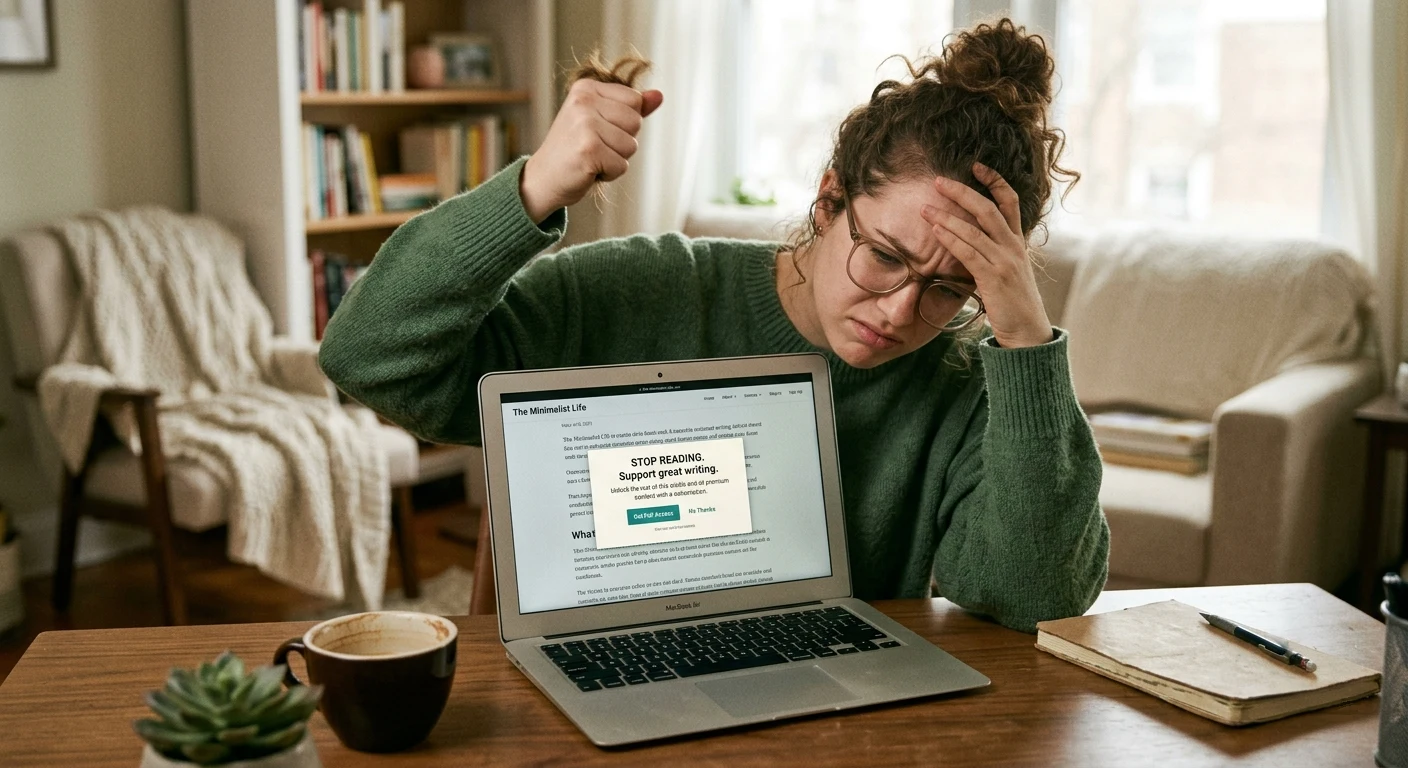
The friction isn't that Medium has a paywall. Metered paywalls are industry-standard - the average across digital publishers is around five free articles per month, so Medium's three-article allowance is actually slightly stingier than the norm, not unusually generous. The friction is what happens around that limit, and how unpredictable it feels as a reader.
A few things compound this:
You don't know your limit is coming until you hit it. Unlike a newspaper site that might show "2 of 5 free articles remaining," Medium's meter isn't something most casual readers track. You click an interesting link from Twitter or a Google search, read two paragraphs in, and the wall appears mid-sentence.
Writers are financially incentivized to paywall, not to keep things open. This isn't a criticism of individual writers - it's just how the system is built. One widely shared piece of advice for writers in the Medium Partner Program is to paywall roughly three articles for every one left free, because free articles don't earn anything through the program. That's a completely reasonable choice for a writer trying to make money. But it means the reader's experience of "how much can I actually read here for free" depends entirely on thousands of individual writers' monetization choices, not a predictable site-wide policy.
Audio narration isn't guaranteed to be free, even when you're logged in. In my own experience, clicking "Listen" on a random article led straight to a subscription page instead of playing anything. I can't say for certain whether that specific story happened to be a paywalled Partner Program piece - Medium doesn't make the reasoning obvious in the moment, and that's part of the problem. A reader shouldn't have to reverse-engineer a platform's monetization logic just to know whether pressing "play" will work.
None of this makes Medium bad. It makes Medium a platform optimized for a specific goal: converting casual readers into paying members. That's a legitimate business decision. It's just not the same goal as "make every feature usable for every reader, every time" - and that gap is where a lot of reader frustration comes from.
What we built instead
Elvin isn't trying to out-scale Medium. Five college students writing after class aren't going to out-publish a platform with a decade of head start and 100 million monthly visitors. What we can control is what happens once someone actually lands on an article.
So here's the rule we built the whole site around: every feature works the same way for every reader, signed in or not - with one narrow exception. If you're not signed in and you try to like, bookmark, or comment, we'll ask you to make a free account, because those actions need to be tied to something. Everything else - reading full articles, browsing categories, using the RSS feed, changing the theme, and listening to the audio narration - works exactly the same whether you've made an account or not.
Try it below. Toggle between "Elvin-style" and "Gated-site style" to feel the difference, not just read about it.
Sample article
Why the best ideas show up messy first
The best ideas rarely arrive polished. They show up messy, half-formed, argued out loud in a dorm room or typed at 2 a.m. before the doubt creeps back in.
Most publishing platforms meter this moment. You get a few free reads a month, and once you're out, the rest of the sentence just stops mattering - replaced by a subscribe button and a headline you'll never finish.
That's not a flaw in any one writer's work. It's a business model wearing the shape of an article.
We built Elvin the other way around: nothing is ever metered. Every essay reads start to finish, every time, whether you've made an account or not.
Continue reading with a free account
You've reached your free article limit for this month. Sign up to keep reading.
Sign up to continueA few specifics on what that actually means in practice:
- No metered paywall, ever. Every article is fully readable, first sentence to last, for every visitor.
- No forced sign-in to read. You never need an account to consume content - only to leave a trace of having engaged with it (like, bookmark, comment).
- Free audio narration on every article, with line-sync highlighting and auto-scroll, available to signed-out readers exactly like signed-in ones.
- An RSS feed, for readers who'd rather not be tracked, notified, or nudged at all, and just want new posts to show up in their reader of choice.
- Five distinct voices, one place to find your favourite. Every piece is written by one of five writers, each with their own interests, personality, and perspective. Over time, you might find yourself coming back to one writer because you like the way they think about things - much like having a YouTube creator whose videos you always want to watch. And because there are only five of us, you can actually get to know the people behind what you read.
The site itself is hand-built rather than with a site-builder. Partly that's a philosophical choice: we wanted to understand every line of our own site. Partly it's practical - a lighter site loads faster and doesn't drain your entire battery under an hour, especially on the older laptops most college students are actually using.
So, Is Medium still relevant in 2026?
Yes, Medium is still relevant in 2026. And if you're wondering whether Medium is worth it for writers in 2026, the answer is also yes for many writers - particularly those who value reach, discovery, and access to an existing audience.
Medium's relevance doesn't mean it is automatically the best publishing platform for everyone. If you want maximum reach as a writer, or you want algorithmically surfaced writing from a massive, varied pool of authors, Medium remains genuinely useful. Its Partner Program also gives writers a way to earn from their work. It earned its place.
But if you're a reader who's tired of hitting invisible limits mid-article, unsure whether a feature will work until you've already clicked it, and would rather just read - that's a different need, and it's the one we built Elvin to serve. Medium can still be worth using, but it doesn't have to be the only place you publish or read.
If you're deciding between Medium and an independent blog in 2026, the trade-off is fairly simple: Medium gives you distribution; an independent site gives you control. Medium has the advantage of an established audience and discovery system. Your own site gives you much more control over branding, monetization, reader relationships, and the overall experience.
And maybe that's the other difference. Elvin isn't an endless pool of writers you'll never see twice. There are five of us. Read enough, and you'll probably start recognizing who wrote something before you even reach the byline - and maybe find the writer whose perspective you keep coming back for.
If that sounds like your kind of reading, browse Elvin's categories or subscribe to our RSS feed - no account required either way. Medium is still relevant in 2026, and it can still be worth it for writers, but readers and writers have more alternatives than they did when Medium first became popular.
Sources
- Medium Help Center - free monthly article access model
- ExpandedRamblings - Medium traffic and monetization statistics, 2026
- Casey Botticello, Blogging Guide - Medium monthly active user estimates
- Blogging Guide - Medium Partner Program enrollment figures
- Zuora - Industry-standard metered paywall practices
- byburk.net - Medium writer paywalling strategy and ratios
How many free articles can I read on Medium each month without paying?
Unauthenticated visitors can read three free articles per month without signing up. Additionally, any stories that writers choose to keep outside of the metered paywall can be read for free indefinitely.
How does the Medium Partner Program compensate writers?
Medium pays enrolled writers based on member reading time rather than pageviews or advertising revenue. Although payouts are heavily concentrated among a small group of top earners, this system serves as an alternative to traditional ad-supported blogging.
What is the main trade-off for writers choosing between Medium and an independent blog?
The choice comes down to distribution versus control. Medium provides access to an established, built-in audience and discovery system, making it easier to be found. An independent site gives you full ownership of your reader relationships, branding, monetization, and the overall reading experience, but requires you to build your own audience from scratch.
How does Elvin handle reader access compared to Medium?
Elvin does not use metered paywalls, meaning every article is fully readable from start to finish for everyone. Features like audio narration and category browsing do not require an account. Readers only need to create a free account if they want to perform interactive actions like liking, bookmarking, or commenting.